
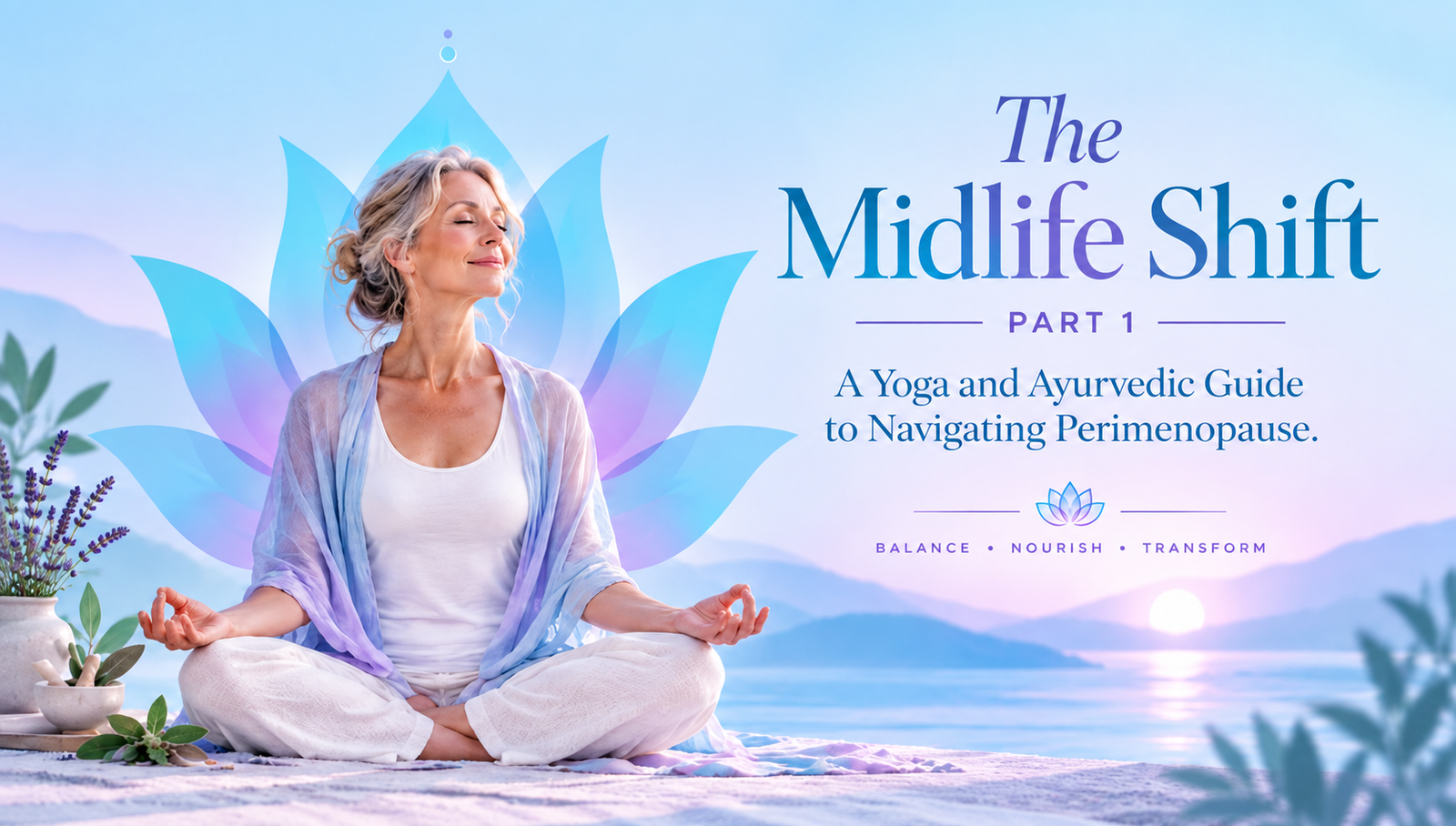
Maybe your periods are no longer as predictable
as they once were. Perhaps you're waking up at
night for no obvious reason, feeling warmer than
usual, becoming irritated more easily, or noticing
that your energy and mood seem different from one
week to the next.
And somewhere in the middle of all these changes,
you may find yourself wondering:
For many women, this is how perimenopause begins—not with one dramatic change, but with a collection of small shifts that gradually become harder to ignore.
Perimenopause is the transition leading up to menopause. During this time, hormonal patterns change, and women may experience changes in their menstrual cycle along with symptoms such as hot flashes, sleep difficulties, and mood changes.
But while modern medicine helps us understand the hormonal side of this transition, Yoga and Ayurveda offer another lens through which we can explore how our changing bodies, minds, and daily rhythms may need different kinds of support.
Perimenopause Is a Transition, Not a Personal Failure
One of the most difficult parts of perimenopause can be feeling as though your body has suddenly stopped behaving the way it used to.
You may be doing the same things you've always done—working, exercising, caring for your family, managing responsibilities—yet your body responds differently.
You may need more recovery.
Stress may feel harder to shake off.
Your usual workout may suddenly feel exhausting.
Your sleep may become lighter.
Or you may find yourself feeling restless and
overwhelmed even when everything around you seems
fine.
This doesn't mean you have somehow lost control of your body.
It means your body is moving through a significant stage of life, and some of the routines that supported you earlier may need to change with you.
This is where the traditional wisdom of Ayurveda for perimenopause can offer an interesting perspective.
How Ayurveda Looks at the Midlife Shift
Ayurveda is a traditional Indian system of health that looks at wellbeing through factors such as constitution, lifestyle, diet, environment, and daily rhythms. Its concepts should be understood as a traditional wellness framework rather than as established biomedical physiology.
Within Ayurvedic philosophy, different stages of life are associated with different energetic qualities.
Early and middle adulthood are often associated with Pitta—the qualities of heat, drive, ambition, responsibility, and action.
Think about those years.
Building a career.
Raising a family.
Meeting deadlines.
Running a household.
Solving problems.
Achieving one goal and immediately moving
toward the next.
Then, as we move further into midlife, Ayurveda describes a gradual transition toward Vata, which is traditionally associated with movement, change, lightness, creativity, reflection, and greater sensitivity.
Perimenopause often happens right around this transition.
That is one reason Ayurveda doesn't necessarily ask,
Instead, it encourages another question:
Why Perimenopause Can Feel Different for Every Woman
This is one of the most important things to understand.
There is no single perimenopause experience.
One woman may say:
"I'm constantly hot. I feel impatient,
irritated, and I can't tolerate things
that never bothered me before."
Another may say:
"I'm exhausted but I can't switch off.
My sleep is terrible, my mind keeps racing,
and I feel anxious for no clear reason."
Someone else may experience a combination of both.
In an Ayurvedic framework, the first pattern may show more Pitta-like qualities such as heat and intensity, while the second may show more Vata-like qualities such as restlessness, dryness, irregularity, and excessive movement.
This is also why a completely generic approach may not feel right for everyone.
Your yoga practice, breathing exercises, recovery, food habits, and daily routine may need to reflect what you are experiencing rather than what worked for somebody else.
Understanding Apana Vayu During Perimenopause
Another concept used in Ayurvedic and yogic philosophy is Apana Vayu.
Traditionally, Apana Vayu refers to the downward-moving aspect of Vata associated with functions such as elimination and menstruation.
During the reproductive years, menstruation creates a regular monthly rhythm. As cycles begin to change during perimenopause, an Ayurvedic practitioner may look at how a woman's overall routines, stress, sleep, movement, and grounding practices are supporting that changing rhythm.
You don't need to understand complicated Ayurvedic terminology to benefit from the central idea.
It may be to create more stability, grounding, rest, and awareness.
Where Yoga Fits Into Perimenopause
This is where yoga for perimenopause can become valuable.
Not because one pose can magically “balance your hormones,” and not because yoga should replace appropriate medical care.
Yoga gives us tools for movement, breathing, relaxation, body awareness, and stress management.
Research suggests that yoga may help with some menopausal symptoms and appears to be at least as effective as other forms of exercise for some symptoms. Studies have also explored potential benefits for stress, sleep, and emotional wellbeing.
But your practice doesn't always need to look the way it did in your twenties or thirties.
This stage may be less about:
How much can I do?
and more about:
How do I feel after I do it?
Do you finish your yoga practice feeling calmer
and more grounded?
Or depleted?
Does a vigorous practice leave you energised?
Or more overheated and irritable?
Do you need intensity today?
Or would slower movement, restorative postures,
and breathing practices serve you better?
Learning to notice these differences can become an important part of your midlife practice.
Start by Listening Before Trying to Fix Everything
If you're entering perimenopause, you don't need to completely redesign your life overnight.
Start by paying attention.
Notice your sleep.
Notice your energy.
Notice whether you're frequently feeling hot
or cold.
Notice how stress affects you.
Notice which foods, activities, and routines
leave you feeling settled—and which leave you
feeling more depleted or restless.
Most importantly, allow your yoga practice to change.
A practice that once needed to challenge you may now need to support you.
It is learning to work with the body you have today.
Coming Next: Is Your Perimenopause More Vata or Pitta?
In Part 2 of The Midlife Shift, we'll explore the differences between Vata-dominant and Pitta-dominant perimenopause patterns in more detail.
We'll look at the common signs of each pattern and explore how yoga postures, breathwork, daily routines, and lifestyle choices may be adapted accordingly.
Because perimenopause isn't one experience—and your practice shouldn't have to be one-size-fits-all either.
Ready to Create a More Supportive Midlife Routine?
Ready to create a practice that works with your changing body rather than against it?
Book Your Private Perimenopause ConsultationImportant: Yoga and Ayurvedic practices can complement your overall wellbeing but are not substitutes for medical diagnosis or treatment. Speak with a qualified healthcare professional about new, severe, or persistent symptoms.